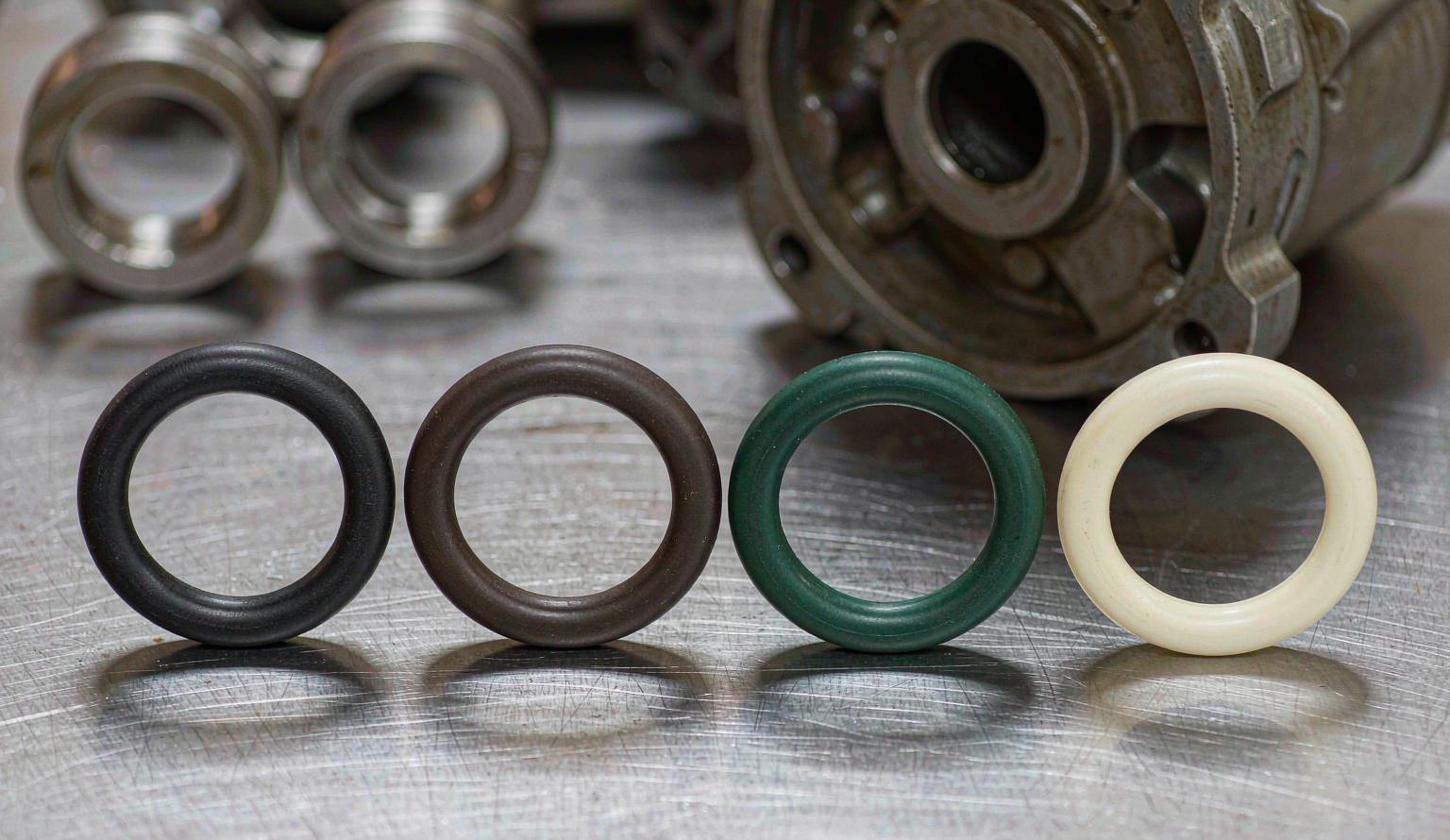
Four elastomer families cover almost every oilfield sealing application: HNBR, FKM, AFLAS (TFE/P) and FFKM perfluoroelastomer, compared across service. Typically the four are presented as a ladder — cheap to expensive, ordinary to premium — which is a convenient shorthand and a poor way to specify a seal. Every one of the four has a service condition it fails in, and the only condition that matters is the one your well can actually deliver.
This article is a selection matrix rather than a materials lecture: which family fits which duty, where only one answer survives, and where paying for the premium elastomer buys you nothing.
The four families, and what actually separates them
HNBR (hydrogenated nitrile). A saturated nitrile backbone. Excellent resistance to hydrocarbon oils, good abrasion resistance and the lowest cost of the four. Its temperature ceiling is modest and its resistance to aggressive chemicals is limited, but in sweet, moderate-temperature service — and at higher hardness in abrasive duties — it remains the value choice.
FKM (fluoroelastomer). The Viton-class family. Broad chemical resistance, good high-temperature performance and excellent resistance to aromatic hydrocarbons, ketones and fuels — which is exactly where TFE/P struggles. The structural weakness is the vinylidene fluoride (VDF) unit in the polymer chain: in strongly basic media it undergoes dehydrofluorination, and the seal hardens, cracks and loses strength.
AFLAS (TFE/P, FEPM). A copolymer of tetrafluoroethylene and propylene, and the only one of the four with no VDF in the backbone — so there is no hydrogen-fluoride elimination route for bases to attack. It is the conventional choice for steam and hot water, amine and caustic service, sour gas and high-pH oilfield chemistry, and it has outstanding electrical resistivity, which matters inside a motor protector. Its weak points are aromatic solvents, ketones and esters, and low-temperature flexibility.
FFKM (perfluoroelastomer). A fully fluorinated network. The widest chemical and thermal envelope of the four, the best compression-set behaviour at temperature, and the highest price by a wide margin. It is the right answer when nothing else will survive, and an expensive answer when something cheaper would have run to the next pull.
Selection matrix: match the family to the service
The table below is organised by service condition rather than by property, because that is the order in which a well decides the answer. Ratings are relative between the four families, not absolute.
| Service condition | HNBR | FKM | AFLAS (FEPM) | FFKM |
|---|---|---|---|---|
| Sweet crude and dry gas, moderate temperature | First choice | First choice | Suitable | Over-specified |
| Hot oil reservoir, 150 °C and above | Not suitable | Suitable, grade dependent | First choice | Suitable |
| Steam injection, SAGD, geothermal | Avoid | Avoid | First choice | Suitable |
| Sour service, elevated H₂S partial pressure | Marginal, high hardness only | Avoid unless qualified | First choice | First choice |
| Amines, caustic and high-pH chemical service | Marginal | Avoid | First choice | First choice |
| Aromatic solvents, ketones, methanol-rich streams | Suitable | First choice | Avoid | First choice |
| High-GOR gas with rapid pressure cycling (RGD) | Qualified grades only | Qualified grades only | Qualified grades only | First choice |
| Abrasive produced sand, high water cut | First choice | Suitable | Suitable | Suitable, costly |
| Protector bag membrane duty (static, slow cycling) | Marginal | Marginal | First choice | Suitable |
Comparative guidance only. Performance is a property of the specific compound, cure system, hardness and filler package — always specify against a compound datasheet and a qualification report for the exact grade, never against a polymer name.
Four conditions where the matrix has only one sensible answer
Steam and hot water. Above roughly 150 °C in saturated steam, FKM compounds harden and lose tensile strength, and HNBR follows. TFE/P was built for this duty, which is why AFLAS is standard in steam-injection and SAGD wellheads, and why our 456 AFLAS bag exists.
Amines and caustic. Amine-based corrosion inhibitors and high-pH water floods destroy FKM by dehydrofluorination. If the injected chemical package contains an amine, FKM is off the table regardless of its temperature rating.
Sour service. H₂S attacks the polymer network and permeates the seal, acidifying the fluid behind it. Selection here is governed by NACE MR0175 / ISO 15156, and the qualification applies to the specific compound and hardness — not to the family.
Gas cycling. Where pressure falls quickly during shutdown or blowdown, dissolved gas expands inside the elastomer faster than it can diffuse out, producing blisters and internal cracks. RGD resistance is proven by test: NORSOK M-710 and ISO 23936-2 both soak the material in a gas mixture at pressure and temperature, then decompress it through repeated cycles. API 6A material classes FF and HH apply the same logic to wellhead equipment.
Where the cheaper families still win
Over-specification is a real cost: FFKM in a sweet, 90 °C water-injection pump is money that never comes back. HNBR remains the correct choice for sweet hydrocarbon service with modest temperature and abrasive solids, and FKM earns its place wherever aromatic hydrocarbons, ketones or fuel contact dominates — the one service where AFLAS is the wrong answer.
The ESP protector is a special case. Its bag is a static-to-slow-cycling membrane, not a dynamic shaft seal, so AFLAS’s weakness — compression set and low-temperature flexibility — costs less than it would in a rotating application, while its strengths map onto the conditions found at the bottom of a well. That is the logic behind the 562 bag protector and the 540 bag protector, and it is why the same polymer family appears in our AFLAS O-rings.
An eight-step selection sequence
Work through these in order. Stopping at step two is how most mis-specified seals happen.
- List every medium the seal will contact — crude or condensate, produced water and salinity, CO₂, H₂S in ppm, injected chemicals, and any commissioning fluids.
- Establish partial pressures, not just concentrations. H₂S and CO₂ severity is set by partial pressure at temperature, which is what NACE MR0175 / ISO 15156 evaluates.
- Define the temperature profile — maximum continuous, maximum short-term excursion, and minimum during a cold start.
- Characterise the pressure cycle, including decompression rate, to decide whether RGD qualification is required.
- Classify the motion — static, slow cycling or dynamic — because it changes how much compression set actually matters.
- Shortlist by matrix, then eliminate any family with a known failure mode in your medium.
- Select the compound, not the family, and request the qualification documents below for that exact grade and hardness.
- Verify geometry and hardware — gland dimensions, extrusion gaps, back-up rings and installation method — because most “material failures” are extrusion or installation damage.
What to ask for before you approve a compound
A supplier claim of “AFLAS” or “FFKM” tells you almost nothing on its own. Ask for the compound datasheet plus test evidence against recognised methods: immersion testing to ASTM D471 for volume swell and hardness change in your actual media, compression set to ASTM D395 at your service temperature, RGD and ageing qualification to NORSOK M-710 or ISO 23936-2 where gas is involved, and sour-service qualification to NACE MR0175 / ISO 15156 for H₂S duty. For wellhead equipment, the API 6A material class requirements apply as well.
Frequently asked questions
Is AFLAS the same as FKM?
No. Both are fluoroelastomers, but they are different polymers. FKM is based on vinylidene fluoride copolymers; AFLAS is a tetrafluoroethylene–propylene copolymer, designated TFE/P and classified as FEPM. AFLAS contains no VDF, which is why it survives amines, caustic and steam that degrade FKM — and why FKM outperforms it in aromatic solvents and ketones.
Which of the four is best for H₂S service?
TFE/P (AFLAS) and FFKM are the two families routinely specified for sour service, with HNBR used at higher hardness where temperatures stay moderate. Because H₂S resistance is compound-specific, ask for the NACE MR0175 / ISO 15156 qualification of the exact grade rather than accepting a family-level claim.
Can I use FFKM everywhere and stop worrying about selection?
You can, but you will pay an FFKM price and still not solve geometry, extrusion or installation problems. FFKM is the right answer when no cheaper family survives.
Does a higher temperature rating mean a longer seal life?
Not by itself. Seal life is decided by the combination of temperature, chemical exposure, compression set, pressure cycling and installation. A 200 °C-rated compound in amine service will fail before a correctly selected grade in the same well, because chemistry, not temperature, sets the limit.
How do I know whether RGD qualification is required?
If the seal sees gas at pressure and the pressure can fall quickly — shut-in and blowdown, gas lift, high-GOR wells — then yes. RGD resistance is verified by test under NORSOK M-710 or ISO 23936-2, and it must be verified for the specific compound and hardness you intend to install.
Selection is a run-life decision, not a purchasing decision
Pick the family by failure mode, then the compound by test evidence, then verify the hardware around it. That sequence separates a seal that reaches the next planned pull from one that forces an early workover.
ESP Protector manufactures AFLAS elastomer bag protector seals in Haining, Zhejiang, China, across the 456, 540 and 562 protector ranges, together with wye-point connectors and AFLAS O-rings. Send us your well conditions — temperature, pressure, H₂S and CO₂ partial pressures, water cut and protector model — and we will recommend the material and compound rather than just quote a part number.