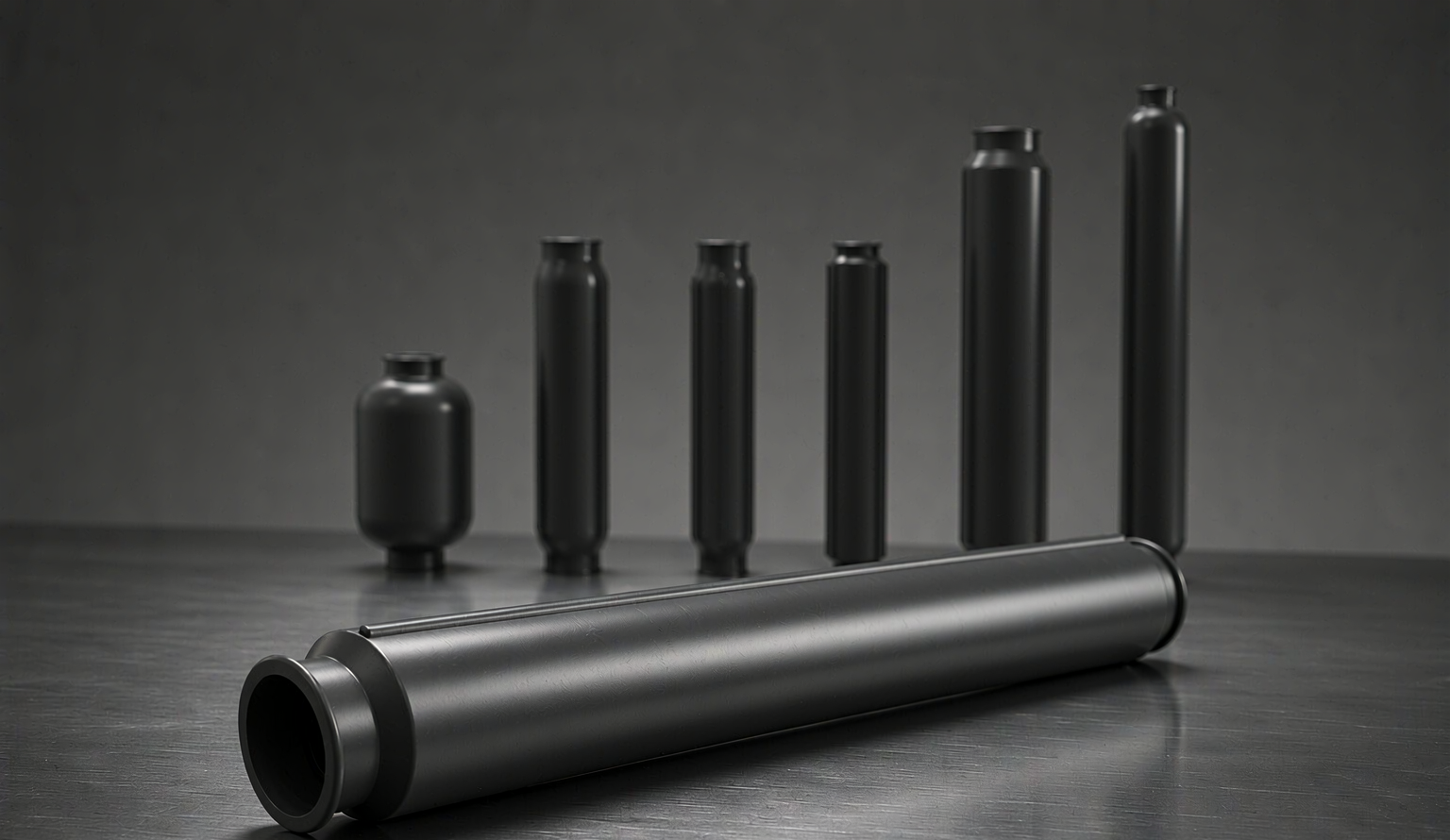
In an electric submersible pump (ESP) installation, the component that most often decides whether a string runs for two years or for two months is not the pump and not the motor. It is the protector — and inside a bag-type protector, it is the elastomer bag that actually stands between your motor oil and the well.
Once that bag is breached, well fluid reaches the dielectric motor oil, insulation resistance collapses and the motor windings fail. The consequence is a workover: pulling the entire string to replace a part that costs a fraction of the intervention. This article explains what ESP bag protector seals do, the five ways they fail in petrochemical and drilling service, and how to specify the correct elastomer for the well you actually have.
What an ESP bag protector seal actually does
The protector — also called the seal section — sits between the motor and the pump intake and performs three separate jobs at the same time:
- Isolation. The elastomer bag is a physical barrier between well fluid on one side (produced water, brine, crude, gas, sand, scale) and clean dielectric motor oil on the other.
- Pressure and volume compensation. When the motor runs, the oil heats and expands; when it stops, the oil cools and contracts. The bag stretches and relaxes to absorb that thermal volume change, so the motor neither over-pressurises nor draws a vacuum against its own shaft seals.
- Thrust support. The protector carries the thrust bearing that absorbs the axial load generated by the pump, so that load is not transmitted into the motor.
Most operators run protectors in tandem, because the first chamber is the one that takes the chemical and mechanical abuse. If the first bag is compromised, the second chamber still stands between contamination and the motor. Our 562 bag protector is built around exactly these three functions, with an AFLAS fluororubber bag as the primary well-fluid barrier.
Failure mode 1: chemical attack in sour, amine and steam service
This is the failure mode that catches operators out most often, because the seal is destroyed by chemistry rather than by load.
Sour service (H₂S). Hydrogen sulfide is aggressive to elastomers in two ways: it attacks the polymer network, and it permeates the material and acidifies the motor oil from the inside. Standard FKM (Viton-type) compounds degrade noticeably in sour service, and their performance varies enormously between formulations. Where H₂S is present, selection is governed by NACE MR0175 / ISO 15156, and the qualification applies to the specific compound and hardness, not to the material family.
Amines and caustic. Amine-based corrosion inhibitors and gas-treating solvents are a classic FKM killer. FKM contains vinylidene fluoride (VDF) units; in strongly basic media those units undergo dehydrofluorination, and the seal hardens, cracks and loses tensile strength. TFE/P elastomers such as AFLAS (FEPM) were developed precisely for this gap: they contain no VDF, so there is no adjacent C–H / C–F pair to eliminate hydrogen fluoride from, and they resist amines and strong bases that destroy FKM.
Steam and hot water. Steam injection wells, SAGD operations and geothermal applications expose the bag to saturated steam at 200 °C and above. In continuous saturated steam testing, FKM compounds harden and lose more than half their tensile strength, while TFE/P grades retain the majority of theirs. This is why AFLAS is the conventional elastomer choice for steam-injection and SAGD wellheads — and the reason our 456 AFLAS bag exists.
Failure mode 2: thermal limits and compression set
Elastomer bags live at the bottom of the well next to a motor that is deliberately hot, and they do it while flexing every time the pump cycles.
As a practical ceiling, most elastomer protector bags are rated to about 200 °C continuous. TFE/P (AFLAS) grades are typically specified from −10 °C to +200 °C continuous, with short-term excursions to 230–250 °C depending on the compound. Above that band, elastomers lose elasticity and become brittle; conventional practice at those temperatures is a metal bellows protector, which is also impervious to H₂S permeation but far more expensive and less tolerant of solids.
Compression set matters just as much. A material with poor compression-set recovery will take a permanent deformation, stop returning to its moulded shape, and eventually split. TFE/P compound compression set at 200 °C is typically in the 20–35 % range — acceptable for the static and slow-cycling duty of a protector bag, but worth knowing when you write the specification.
Failure mode 3: gas permeation
No elastomer is a perfect gas barrier. Under pressure, H₂S, CO₂ and light hydrocarbons dissolve into the bag wall. Two things then happen:
- The gas migrates through the elastomer and enters the motor oil, lowering dielectric strength and raising the risk of an electrical short.
- The dissolved gas changes the chemistry of the bag itself — H₂S in particular tends to harden elastomers, which reduces flexibility exactly where flexibility is the whole point.
Permeation cannot be eliminated with an elastomer, only reduced. Where gas ingress is the dominant risk — high H₂S, high GOR, gas lift — the industry answer is a metal bellows or a tandem protector arrangement.
Failure mode 4: mechanical damage from cycling and abrasives
An expandable membrane that inflates and deflates with every start-stop cycle is a fatigue component. The classic mechanical failures are:
- Splitting and cracking from repeated expansion and contraction, especially after the elastomer has already been embrittled by heat or chemical ageing.
- Extrusion and nibbling where the bag is pinched against metal hardware at pressure.
- Abrasion from produced sand and scale in high-water-cut wells.
Mechanical failures rarely have a single cause. Almost always the sequence is chemical or thermal ageing first, loss of elasticity second, and rupture third — which is why specifying on temperature alone is a mistake.
Failure mode 5: rapid gas decompression (RGD)
In gas-bearing service, pressure does not always fall gently. During a shut-in and blowdown, or a rapid pressure drop, gas that has dissolved into the elastomer expands faster than it can diffuse out. The result is blistering, internal cracking and, in the worst case, complete rupture of the seal — from the inside.
RGD resistance is a property of the specific compound and its hardness, not of the material family. It is verified by test, not by datasheet: NORSOK M-710 and ISO 23936-2 both soak the material in a CO₂/CH₄ gas mixture at pressure and temperature, then decompress at a controlled rate through repeated cycles and inspect for damage. API 6A material classes FF and HH apply the same logic to wellhead and tree equipment. If your well sees gas and rapid pressure changes, ask for the qualification document for the exact compound — not for the polymer name.
Elastomer comparison for ESP bags and downhole seals
| Property | HNBR | FKM | AFLAS (FEPM / TFE-P) | FFKM |
|---|---|---|---|---|
| Continuous service temperature | −40 to +150 °C | −20 to +200 °C | −10 to +200 °C (excursions to 250 °C) | −20 to +320 °C |
| H₂S / sour gas | Fair to good | Poor to fair, grade dependent | Excellent | Excellent |
| Steam and hot water | Fair | Poor | Excellent | Good to excellent |
| Amines and strong bases | Good | Poor | Excellent | Excellent |
| Aromatic hydrocarbons, ketones | Good | Excellent | Poor | Excellent |
| Low-temperature flexibility | Excellent | Good | Poor | Good |
| Electrical insulation | Good | Good | Excellent | Good |
| RGD resistance | Good at high hardness | Highly formulation dependent | Good, qualified grades available | Good, qualified grades available |
| Relative cost | $ | $$ | $$$ | $$$$ |
Typical published ranges for guidance only. Actual performance depends on the specific compound, cure system and fillers — always specify against a compound datasheet, not a polymer name.
For the ESP protector bag specifically, that table explains why AFLAS fluororubber dominates: the duty is static-to-slow-cycling, not dynamic shaft sealing, so AFLAS’s weakness (compression set and low-temperature flexibility) matters less, while its strengths (steam, H₂S, amine resistance, electrical insulation) are exactly the conditions found in oil wells. Our 540 bag protector and AFLAS O-rings are specified on that same logic.
Specification checklist: what to send your supplier
Most premature protector failures trace back to an incomplete specification. Before requesting a quotation, collect these nine items:
- Media composition — H₂S concentration (ppm), CO₂, water cut and salinity, crude or condensate, any injected chemicals (amine-based inhibitors, demulsifiers, acids).
- Maximum continuous and short-term temperature at the protector depth, not at surface.
- Wellbore pressure and the expected decompression rate during shutdowns, for RGD assessment.
- Gas-to-oil ratio and whether the well is gas lifted.
- Required standards compliance — NACE MR0175 / ISO 15156 for sour service, NORSOK M-710 or ISO 23936-2 for RGD, API 6A class where wellhead equipment is involved.
- Sand and solids content, which drives abrasion and extrusion risk.
- Bag geometry — protector model, motor series, casing size.
- Tandem or single configuration, and the redundancy you rely on.
- Storage and shelf life requirements before installation.
Give a supplier those nine points and the bag specification becomes an engineering decision. Give them only a temperature figure and it becomes a guess.
Frequently asked questions
What temperature can an ESP bag protector seal handle?
Most elastomer bags are limited to roughly 200 °C continuous service. AFLAS (TFE/P, FEPM) grades are commonly rated −10 °C to +200 °C continuous with short-term excursions to 230–250 °C, depending on the compound. For wells that run hotter, a metal bellows protector is the conventional alternative.
Which elastomer is best for H₂S service?
TFE/P (AFLAS) and FFKM are the two families routinely specified for sour service, with HNBR used at higher hardness where temperatures stay moderate. Because H₂S resistance is compound-specific, ask for the NACE MR0175 / ISO 15156 qualification for the exact grade rather than accepting a material-family claim.
Is the material in an AFLAS bag the same as an AFLAS O-ring?
Same polymer family, different compound and geometry. The bag is moulded as a thin, highly extensible membrane that must flex with the motor’s thermal oil volume; an O-ring is a compact static or dynamic seal. Both rely on TFE/P’s resistance to steam, H₂S and amines, but the compounds and cure systems are not interchangeable.
Why did the protector fail if the motor temperature was normal?
Because the protector fails silently. There is no sensor inside the seal section, so contamination usually only shows up as rising vibration and then a climbing motor temperature — by which point the oil has already been compromised. This is the practical argument for trending motor temperature and vibration rather than reacting to alarms.
How often should bag protectors be replaced?
At every pull, and always as a matched set with the shaft seals. Storage life also matters: elastomer bags should be kept away from light, ozone, hydrocarbons and deformation, and rotated on a shelf-life basis so that an older bag is not installed into a new string.
Sealing decisions are run-life decisions
The protector is cheap relative to the string it protects and the intervention it forces. Specifying it properly — correct elastomer family, correct compound, complete operating data and the right standard qualification — is one of the few places in ESP design where a small cost difference buys a disproportionate amount of run life.
ESP Protector manufactures AFLAS elastomer bag protector seals in Haining, Zhejiang, China, across the 456, 540 and 562 protector ranges, together with wye-point connectors and AFLAS O-rings. Send us your well conditions — temperature, pressure, H₂S, water cut and protector model — and we will recommend the bag specification rather than just a part number.